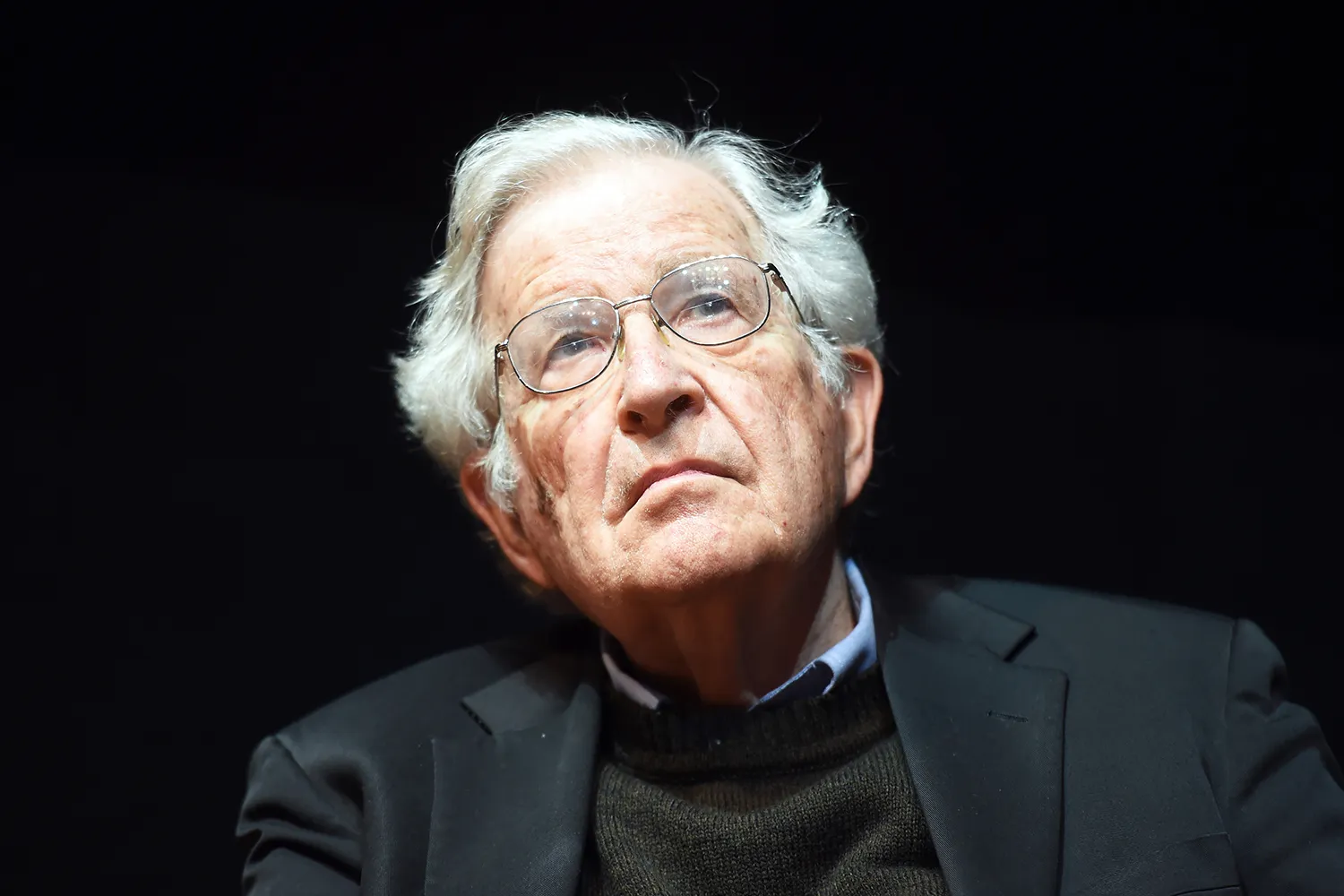
In the mid-1950s, linguistics was a fairly quiet field. The dominant approach — structural linguistics — focused on cataloging and describing languages as they were actually used, pattern by observable pattern. Then a young scholar named Noam Chomsky published a slim book called Syntactic Structures in 1957, and the field was never quite the same. The ideas he introduced didn’t just change how linguists studied language — they changed how scientists understood the human mind.
What Chomsky proposed was a theory called generative grammar: the idea that the human capacity for language isn’t learned from scratch through exposure and imitation, but is instead built into us. We are born, he argued, with a specialized cognitive system for language — a language faculty — that gives us the ability to acquire any human language we’re exposed to in early childhood. The fact that every normal child, in every culture, acquires their native language without formal instruction and without apparent effort is, on this view, not a coincidence. It’s the faculty doing its job.
The Infinite From the Finite
One of the most elegant ideas at the heart of generative grammar is the concept of discrete infinity. Human language is infinite: you can always produce a sentence you have never said before, and a competent speaker will understand it. “The blue elephant on the roof was reading a mystery novel about a detective who feared ladybugs” is almost certainly a sentence no one has ever uttered, but you understood it immediately.
How is this possible? Because language is generated by a finite set of rules that can apply recursively — that is, a rule can apply to its own output again and again. “The cat that chased the dog that bit the man that…” can continue indefinitely. Sentences can be embedded inside other sentences without limit.
The grammar is generative in the technical sense: it generates — or specifies — all and only the grammatical sentences of a language. A generative grammar isn’t a list of sentences (that list would be infinite). It’s a compact, finite system of rules capable of producing an infinite number of sentences. This is what allows children to produce and understand sentences they have never heard before, from the first weeks of language acquisition.
Competence vs. Performance
Chomsky drew a distinction that became fundamental to the field: competence versus performance. Competence is the underlying knowledge of language that a speaker possesses — the internalized grammar, the implicit rules. Performance is what speakers actually produce: the stream of speech, with its hesitations, errors, interruptions, and slips.
Performance is messy. People start sentences and abandon them. They repeat themselves. They make mistakes. But underlying all that mess is a system of knowledge — competence — that is remarkably ordered and consistent. The speaker who says “I, uh, I was gonna — the thing I wanted to say was…” still knows that “Was the thing I say gonna wanted” is not a sentence. Their competence is intact even when their performance is imperfect.
Generative grammar focuses on competence. It is a theory of what speakers know, not simply of what they do. This was a radical shift: linguistics moved from the description of observable behavior toward the investigation of mental structure.
Universal Grammar
If the language faculty is innate, it follows that there must be something universal about it — some core properties that all human languages share, regardless of how different they look on the surface. Chomsky called this Universal Grammar (UG): the set of principles and parameters that are built into the human language faculty and constrain what human languages can be like.
The principles are properties that hold across all languages — things like the existence of grammatical categories (noun, verb), hierarchical phrase structure, and constraints on how rules can operate. The parameters are options that are fixed differently in different languages — things like whether a language requires an explicit subject in every sentence (English does; Spanish and Italian don’t) or what the basic word order is.
Children, on this view, don’t learn language by trial and error across a completely open space of possibilities. They learn it by setting parameters — flipping binary switches — based on input from their environment. The parameters are few; the input does the job of setting them. This would explain why acquisition is so fast, so reliable, and so uniform across cultures.
The Poverty of the Stimulus
One of the key arguments for Universal Grammar is what Chomsky called the poverty of the stimulus (sometimes called Plato’s Problem). Children end up knowing things about their language that they were never directly taught, and that the input they received was not rich enough to justify. They don’t just learn what they’ve heard — they generalize in specific, constrained ways that go beyond the data.
For example, English-speaking children reliably form questions correctly even in complex sentences they’ve almost certainly never encountered in their input. The fact that they don’t make certain types of errors that would be logical given only the surface data suggests, on Chomsky’s view, that they brought something to the task — a pre-existing structure that constrains where the generalizations can go.
Why It’s Still Controversial
Generative grammar is one of the most influential theories in the history of cognitive science, and also one of the most debated. Critics point out that the poverty of the stimulus argument may be overstated — that statistical patterns in the input are richer than early proponents acknowledged, and that children may be more powerful statistical learners than generativists assumed. Constructivist and usage-based theories of acquisition argue that grammar is built up from experience rather than downloaded from an innate module.
The debate between nativist and usage-based accounts is genuinely unresolved and still active. What’s not in doubt is that Chomsky’s framework transformed the questions the field asks: about the mind, about what’s universal in language, about the relationship between biology and cognition. Even those who reject the specifics of UG are working in the space he defined.
Andrew Carnie’s Syntax: A Generative Introduction is the clearest entry point into the technical machinery of generative grammar — phrase structure rules, transformations, tree diagrams — presented for readers with no prior background. If you want to understand what generativists are actually doing when they analyze sentences, Carnie is where to start.
What This Means for You
If generative grammar is right, the human capacity for language is not a general learning ability applied to a particular domain. It is a specialized, biological endowment — as species-specific as upright walking. That’s a remarkable claim, and it has real implications for how we think about language acquisition, language disorders, and the relationship between language and thought.
Even if you find the nativist claims hard to accept in full, the questions Chomsky raised don’t go away. Why do children acquire language so reliably and so fast? Why are there universals across languages that couldn’t plausibly all be explained by function? Why do certain grammatical rules have the specific shape they do?
However the debate eventually settles, asking those questions rigorously has made linguistics a far more interesting discipline. And that, at least, is not controversial.
Disclosure: This article contains affiliate links. If you purchase through one of our links, we may earn a small commission at no extra cost to you.