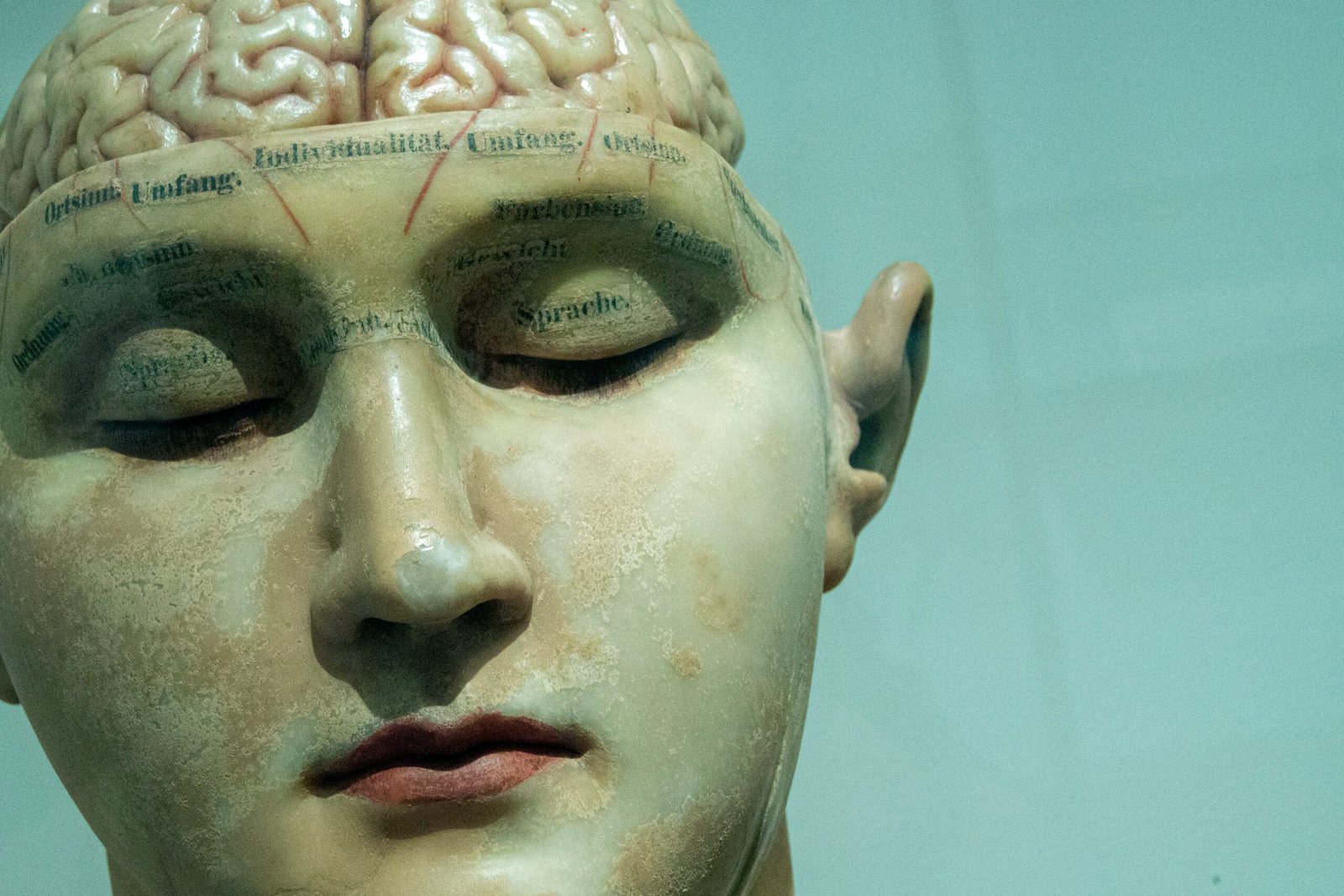
When you think, you often think in words. You run internal monologue. You rehearse arguments. You phrase things to yourself before saying them out loud. Language and thought seem intertwined in a way that’s hard to separate.
When an AI processes your prompt and generates a response, it’s manipulating tokens — pieces of language. Does that mean it’s thinking? And if not, what is it doing?
Do Humans Think in Language?
Before asking whether AI thinks in language, it’s worth asking whether humans do — because the answer is more complicated than most people assume.
Some thought seems to be pre-linguistic: the sudden recognition of a face, the sense that something is wrong before you can articulate why, the spatial reasoning that lets you navigate a room in the dark. Infants clearly have goals, preferences, and rudimentary reasoning before they have language. Deaf individuals who never acquire sign language demonstrate abstract problem-solving. This suggests that some thinking — perhaps a lot of thinking — doesn’t require language at all.
What language does seem to do is allow thought to be communicated, preserved, and extended. It lets you hold an argument across time, share a complex idea with someone else, build on thoughts that other people had long before you. Language displacement — the ability to speak about things not present — may be less a property of thought than of what thought becomes when it is articulated.
This is directly relevant to understanding AI: if language is primarily a medium for communicating thought rather than thought itself, then an AI that processes language might be doing something very different from thinking — while still producing outputs that look like thinking.
What Tokens Are — and Aren’t
When a language model processes your prompt, it converts it into a sequence of tokens: numerical representations of word fragments. These tokens pass through the model’s layers — operations involving billions of learned parameters — and eventually the model selects the next token to output.
At no point is there an internal experience of meaning. There is no moment when the model “grasps” what you’re asking and then “decides” how to respond. There is a cascade of mathematical operations, heavily structured by the patterns learned during training, that produces a probability distribution over possible next tokens.
The tokens are, in this sense, not like words in the human sense. Human words carry meaning because they’re grounded in experience — in perception, action, social context, embodied knowledge accumulated over a lifetime. A model’s tokens are indices into patterns that were learned by predicting other tokens. The connection to the world is indirect, mediated entirely through language that describes the world.
Internal Representations: Not Nothing
Here’s where the picture gets more interesting. Language models don’t just work with the surface tokens. They develop internal representations — dense numerical vectors that encode information about the input in ways that are not directly readable as language.
Researchers who study these representations have found that they encode a surprising amount of structure: syntactic relationships, semantic similarities, factual associations, even something like spatial and temporal reasoning in some cases. The model isn’t just matching surface patterns — it’s developing compressed internal representations that allow it to handle novel inputs it has never seen.
Whether these representations constitute anything like concepts, or whether they’re a very sophisticated statistical encoding that merely resembles conceptual structure from the outside, is genuinely unclear. This is one of the most active areas of research in AI interpretability — the effort to understand what is actually happening inside these systems.
The Question Matters More Than the Answer
For now, what we can say is that AI processes language, learns from language, and generates language — but the processing is so different from human language use that the word “thinking” may not travel across the gap cleanly.
Humans think with language in a way that’s embedded in bodies, histories, goals, and social relationships. AI processes tokens in a way that’s embedded in training data, learned parameter weights, and the next-word prediction objective. The surface output can look remarkably similar. The underlying process is genuinely different.
For the most serious philosophical treatment of what it would mean for a machine to have mind, intentions, or understanding — drawing on cognitive science, philosophy of language, and the history of AI — Human Compatible: Artificial Intelligence and the Problem of Control by Stuart Russell is essential reading. Russell, one of the field’s most prominent researchers, takes seriously both the power of these systems and the deep questions about what they are and what they’re for.
What This Means for You
Asking whether AI thinks in language is really asking two harder questions: what thinking is, and what language is for. Neither has a clean answer.
What’s useful to hold onto is this: AI is not a mind that happens to express itself in words. It is a system that was trained on words and produces words. The words it produces are often useful, often accurate, sometimes remarkable — and they emerge from a process that has no inner life behind it.
That doesn’t make AI uninteresting. It makes it strange in ways that turn out to be illuminating — for what we know about language, about thought, and about what’s distinctive about the human version of both.
Disclosure: This article contains affiliate links. If you purchase through one of our links, we may earn a small commission at no extra cost to you.